
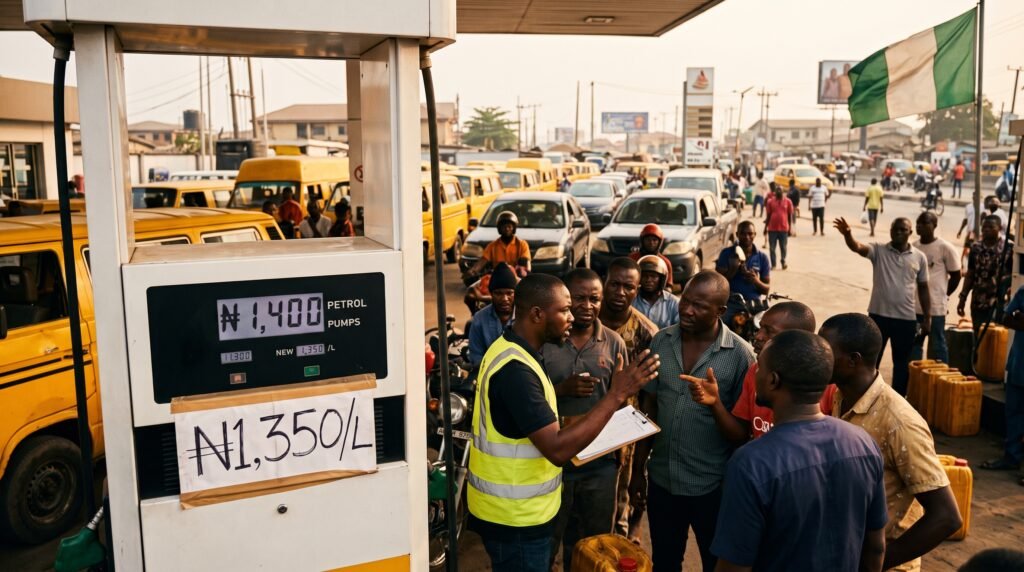
FG Proposes N1,350 Cap on Petrol Cost: What It Means for Pump Prices
- The Federal Government is negotiating a N1,350-per-litre ceiling on the refinery-gate or landing cost of petrol
- The cap is not a pump price. Filling stations will still sell above N1,350
- NNPC will also sell petrol at cost for 30 days, with public transporters first in line
Nigeria’s Federal Government is negotiating a N1,350-per-litre ceiling on the cost of petrol before it reaches filling stations. The aim is to stop pump prices swinging with every move in global crude prices and the naira.
Taiwo Oyedele, Minister of Finance and Coordinating Minister of the Economy, announced the plan at a press briefing in Abuja on Thursday, October 8.
How the ceiling would work
The cap applies to two prices. The first is the ex-gantry price, which is what marketers pay to lift petrol from a local refinery such as Dangote. The second is the landing cost, which is what it costs to bring imported petrol into the country.
It is not a pump price. Transport, distribution and retail margins are added on top, so motorists will still pay more than N1,350 a litre.
If costs rise above the ceiling, refiners and importers will carry the shortfall for now and recover it later, when market conditions ease. The ceiling will be reviewed monthly, and the figures will be published.
“This is neither a subsidy nor price control,” Oyedele said. He argued that a steady N1,400 a litre is better for Nigerians than prices bouncing between N1,500 one day and N1,300 the next.
30-day discount at NNPC stations
Oyedele also announced that NNPC will sell petrol at cost for the next 30 days in the first instance. Public transport operators nationwide will get priority. He stressed that this is not a return to subsidy, because government is simply selling at cost.
The government also plans forward sales of crude oil to domestic refineries, which would lock in a price for a set period. Oyedele gave the example of $80 a barrel for six months.
Where prices stand
NNPC’s latest pump prices are N1,355 a litre in Lagos and Rivers and N1,370 in Abuja. Yobe is the highest at N1,435, followed by Niger State at N1,433.
Before the Middle East crisis pushed Brent crude above $100 a barrel, petrol sold for about N830 a litre. That makes today’s prices roughly 63% to 73% higher. Transport fares and household budgets have taken the hit, and so have the many homes and businesses that run generators on petrol.
Early market reaction
On Friday, October 9, a day after the announcement, several depots in Lagos, Port Harcourt and Calabar cut their prices to N1,350 a litre. Some depots in Warri stayed at N1,360.
What we don’t know yet
The ceiling is still a proposal under negotiation with refiners and importers. Government has not said how or when operators will recover any shortfall. It has also not said what happens if costs stay above N1,350 for months, or how much of the stability will show up at the pump.
Until the details are final, Nigerians should treat N1,350 as a target for supply costs, not a promised pump price.